

Following in the footsteps of the Australian government, the UK announced in June that under-16s are to be banned from social media, with restrictions said to take effect in Spring 2027. A week later, the Prime Minister, Keir Starmer, resigned as leader of his party. Neither of these events is connected, but it does illustrate what a shambles politics is today when governments need to be seen to be taking care of the vulnerable.
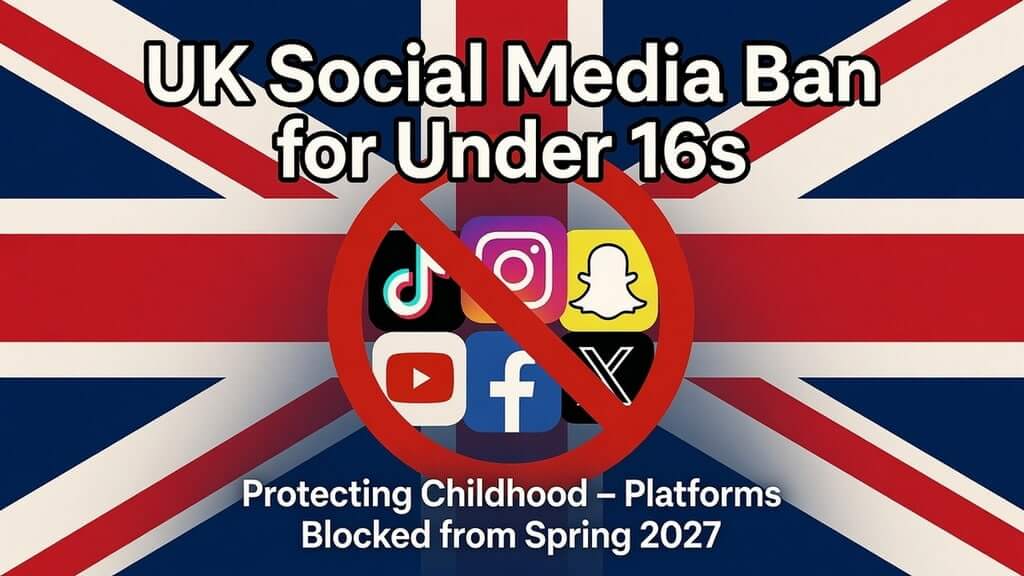
The ban will therefore include platforms like Snapchat, TikTok, YouTube, Instagram, Facebook and X. We do not intend for messaging services like WhatsApp and Signal to be included in the social media ban.
I still maintain that YouTube is not social media, strictly speaking, but hey, I don’t set the rules, unfortunately.
The social media ban for under-16s in Australia is not said to be going according to plan, if recent reports are to be believed. It’s said that between 60 and 80% of those under 16 are still on social media because, as we all predicted, kids are a lot more savvy at tech than most adults. Yes, the very same adult politicians that you voted for – most barely know their way around a PC or a cell phone – bring out legislation hoping for a boost in popularity. I would remind readers that this kind of behaviour can bring down governments – the Poll Tax did that to Margaret Thatcher – because those at the top, and I use that term loosely, didn’t take the temperature of the water first. In Australia, kids are bypassing restrictions by using fake birth dates, VPNs, borrowing accounts, and other means to get around the ban. Don’t politicians realise that this is what VPNs are for? I doubt it. Mind you, programming a VCR back in the day required a PHD in quantum physics, and the only way around that was to call on a twelve-year-old kid!
Will The UK Ban Work?
Back in December, I wrote Australia Under-16 Social Media Ban Now In Effect, and in December 2024, Jim Hillier wrote Australia Bans Social Media For Under 16s, with both of us voicing our opinions to say that, in principle, it’s a fine idea but difficult to control/police. There’s no denying that there’s nasty stuff out there on the web, and it takes all forms, including bullying, which has led to suicides. However, if the UK OSA cannot overcome these issues – VPNs have soared in popularity – I can’t see this ban working in practice.
What do you think?
—

Sorry Marc, I had to smile at your heading: “Will The UK Ban Work?”
I misread it as asking if employment will be next for the chop, lol
Thanks Marc
When you are as cynical as I am you will not see this as anything more than as the beginning of Governmental attempts to rein in and control social media access and other internet access for adults. They know full well if they came out said they were going to start imposing restrictions on mature age people there would be immediate and vocal opposition to their cunning plans. So they bundle it up in a “but it’s to protect our kids” wrapper to silence potential opposition. So now if you, as an adult, want to access certain platforms there is an immediate record of you having done so along with whatever evidence of age identification you have provided – all of which is easily accessible to increasingly authoritarian governments some of whom think nothing of even arresting their citizens and jailing them for social media posts they don’t like !
The reason current left-leaning western Governments are extremely anxious to control platforms like X and wherever else people can get information and news is that they aren’t currently subject to filtering by the like-minded ideological left-leaning media. The fact that governments in the UK and Australia cannot control those narratives on these platforms is the reason we have had early knowledge and details of a variety of incidents and things that matter to us either directly or indirectly . For example, the previously hidden underground networks of grooming gangs in the UK and worse, the extent of the scandalous police and political cover-ups all of which have been almost entirely ignored by the likes of the BBC and Sky News UK. Similarly terrorist attacks and other criminal activities have not been covered accurately with key details of perpetrators’ backgrounds and motivations missing and/or sanitised for public consumption with attempts immediately made to shut down and control narratives in the mainstream media.
As computer enthusiasts we must not be apathetic to these slow but steady government attempts to “boil us frogs slowly” and usher in electronic controls over our adult lives under a variety of “but it’s for the kids !” excuses. I am all for protecting our younger generations, starting with parental responsibility in the home, but as Marc has rightly pointed out in his article, the savvy younger generations can easily currently get around these attempts with one hand tied behind their backs. So now we need to ask ourselves the question – what are these initial amateurish and fumbling internet control attempts really for ? Because if we don’t wake up and push back hard we’ll find one day it will be too late and it will no different than trying to get news coverage and information online in China.
George Orwell warned us in his famous book “1984” of a potential dystopian future. Some may well say that despite his being a few years out the beginnings of that vision are now starting to arrive.
Cheers
Reg