Geek Fact for March 30th
In 1858, the pencil with an attached eraser was patented by Hyman L. Lipman. In 1862, Lipman sold his patent to Joseph Reckendorfer for $100,000. Learn more at http://en.wikipedia.org/wiki/Hymen_Lipman
Learn an interesting fact to share with friends and increase your Geek Cred!
In 1858, the pencil with an attached eraser was patented by Hyman L. Lipman. In 1862, Lipman sold his patent to Joseph Reckendorfer for $100,000. Learn more at http://en.wikipedia.org/wiki/Hymen_Lipman
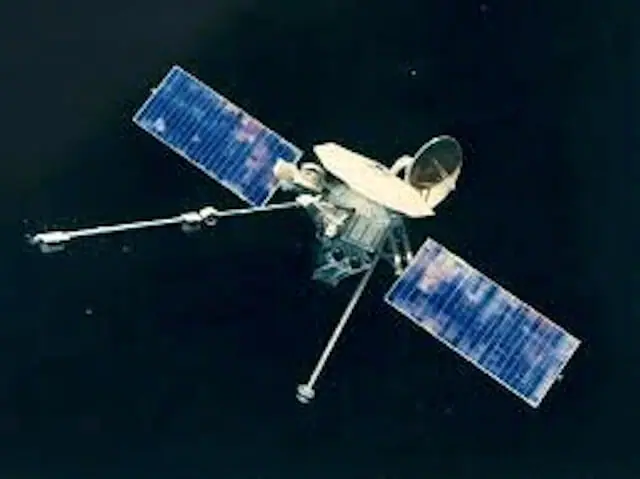
In 1974, NASA’s Mariner 10 became the first space probe to fly by Mercury. Mariner 10 was launched on November 3, 1973. It was also the first spacecraft mission to visit two planets and the first spacecraft to use the gravitational pull of one planet
In 1993, a Type II supernova was detected in M81. Messier 81 (M81, NGC 3031) in Ursa Major is one of the most conspicuous galaxies in the sky. The supernova was discovered by the Spanish amateur astronomer Francisco Garcia Diaz from Lugo, Spain. Learn more
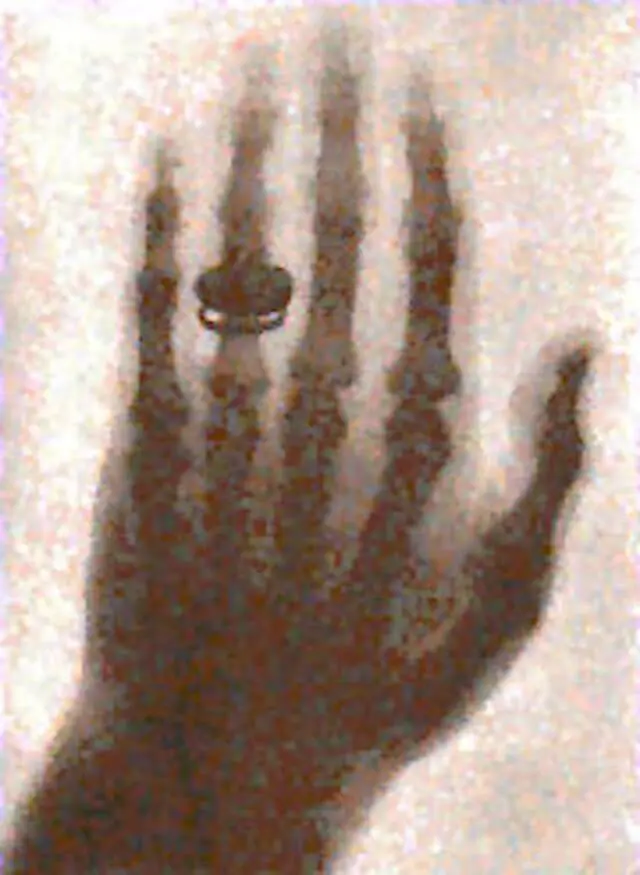
In 1845, scientist Wilhelm Roentgen (Röntgen) was born. He is best known for discovering x-rays. He called them x-rays because ‘x’ is the mathematical symbol for ‘unknown’. The first x-ray he took was of his wife’s hand, shown here. Learn more at http://www.historylearningsite.co.uk/wilhelm_roentgen.htm
In 1936, the Hale telescope, the first telescope with a 200-inch-diameter reflecting mirror, was shipped from Corning, New York to Mt. Palomar Observatory in California. The lens of the Hale telescope weighed 20 tons. It took two weeks by train, at a maximum speed of
In 1928, U.S. astronaut James A. Lovell Jr. was born. James Lovell had several “firsts” – the first to complete 4 spaceflights, the first to make 2 flights to the Moon and man’s first flight around the Moon. In addition, he was aboard Gemini 7
In 1930, the planet Pluto was named. The name Pluto was suggested by Venetia Burney, an 11-year old school girl in England. Due to stricter guidelines put in place in 2006 defining what a planet is, Pluto is no longer considered to be a planet.
In 1965, Gemini 3, the first U.S. 2-man space flight, launched. Gemini 3 was the first crewed Earth-orbiting spacecraft of the Gemini series. It was piloted by astronauts Virgil “Gus” Grissom and John Young. Learn more at http://nssdc.gsfc.nasa.gov/nmc/spacecraftDisplay.do?id=1965-024A
In 1993, Intel introduced the Pentium processor (80586). Codenamed P5, the Intel Pentium was a replacement for the 80486 processor and originally sold for $878.00. Learn more at http://www.computerhope.com/jargon/p/pentium.htm
In 1884, US mathematician George D. Birkhoff was born. In 1931, Birkhoff’s discovered what is now called the ergodic theorem. Ergodic theory is a branch of mathematics that studies dynamical systems with an invariant measure and related problems. Learn more at http://en.wikipedia.org/wiki/Ergodic_theory
In 1891, Dayton Scale Company, the first computing scale company, was incorporated in Dayton, Ohio. It was part of the Computing-Tabulating-Recording Company and became an IBM division in 1933. The Dayton Scale Division was eventually sold to the Hobart Manufacturing Company. Learn more at http://www-03.ibm.com/ibm/history/exhibits/attic2/attic2_057.html
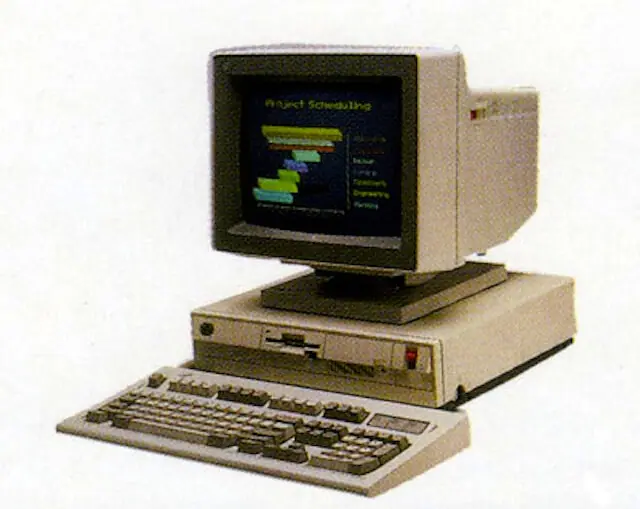
In 1985, IBM announced that it was planning to stop making the PCjr consumer-oriented computer. The PCjr had been expected to dominate the home computer market but, in the 16 months that it was on the market, only 240,000 units were sold. Learn more at
In 2003, Adam Osborne, founder of Osborne Computer Corporation, died. In 1981, Adam Osborne introduced the first portable computer, the Osborne 1. The computer weighed 23.5 pounds and cost $1,795. Learn more at http://entrepreneurs.about.com/od/famousentrepreneurs/p/adamosborne.htm
In 1782, Dutch mathematician Daniel Bernoulli died. The Bernoulli Principle states that the pressure of a fluid, liquid or gas decreases as its speed increases. Learn more at http://plus.maths.org/content/daniel-bernoulli-and-making-fluid-equation